Electric utility vehicle fabrication turns a transport requirement into a vehicle built around real work. For businesses, campuses, factories, resorts, and institutions, the right solution must balance capacity, route length, charging access, safety, and daily use. That is where custom electric vehicles, electric fleet vehicles, electric shuttle bus, EV fabrication Pakistan, and electric powertrain planning matter. Smart fabrication doesn’t begin with the biggest battery or longest claimed range. It begins with the duty cycle. Battery type, motor output, controller, body configuration, dimensions, and useful options should then support that job without adding needless cost or complexity.
Pakistan is also developing a wider new-energy transport framework. The Ministry of Industries and Production currently lists the New Energy Vehicles Policy 2025–30 as national policy, while government material places electric and other new-energy vehicles within a broader shift covering several vehicle classes.
“We don't just build vehicles. We build purpose-driven mobility.”
That idea on the AE Works website captures the central principle behind useful custom fabrication: the vehicle should fit the operation rather than force the operation to fit the vehicle.
What Is Electric Utility Vehicle Fabrication and How Does It Work?
Electric utility vehicle fabrication starts by defining the work the vehicle must perform each day. Passenger demand, route distance, gradients, road width, charging time, and operating conditions influence the final specification. A sound vehicle manufacturing process connects every major component with a measurable operational need instead of chasing impressive numbers without context.
The approach differs from high-volume electric vehicle manufacturing. Large automotive plants may develop a pilot-scale assembly line, pilot production line, and several sub-assembly lines before full production begins. Custom vehicle fabrication works on a different scale. Its value comes from matching configuration, usability, and equipment to the customer’s actual transport problem.
Electric Utility Vehicle Fabrication Versus Mass EV Production
Large factories often use lean manufacturing, automated production controls, repeatable workstations, and formal quality control to build identical units efficiently. Purpose-led fabrication requires more application-specific judgement. AE Works states that it first understands the industry and operating requirement, then plans, builds, and prepares the solution for its intended environment.
Where Electric Utility Vehicles Fit Into Modern Fleet Operations
Electric utility vehicles can work particularly well where journeys are short, repeated, and reasonably predictable. Corporate properties, educational campuses, industrial facilities, resorts, gated environments, and large organisational sites can create these conditions. AE Works positions its mobility and fabrication solutions across commercial, industrial, institutional, hospitality, education, and corporate applications.
The broader electric market extends much further. It includes buses, passenger vehicles, medium-duty electric trucks, heavier commercial vehicles, and other medium-duty vehicles. Some international applications also use range-extended vehicles, where another onboard energy source supplements electric propulsion. These are useful industry concepts, but they are not currently listed as AE Works electric-shuttle models.
Why Predictable Routes Help Electric Fleet Planning
A repeatable route gives a fleet manager valuable data. Daily kilometres, passenger peaks, idle periods, and charging windows become easier to estimate. Range also changes with operating conditions. The U.S. Department of Energy notes that temperature, rapid acceleration, heavy loads, and significant inclines can reduce an EV’s practical driving range.
Start With the Duty Cycle Before Fabricating an Electric Vehicle
A duty cycle is simply the vehicle’s working day translated into numbers. It covers distance, trips, passenger load, stops, gradients, idle time, and charging opportunities. Getting this right prevents costly mismatches because battery capacity, motor demand, fleet availability, and real operating costs all depend on how the vehicle actually works.
Start with daily route kilometres and peak passenger numbers. Then examine slopes, road surfaces, turning areas, operating hours, and parking space. Charging access deserves equal attention. A vehicle might have enough theoretical range for the route, yet still cause downtime if charging clashes with peak transport periods or another shift begins too quickly.
A Practical Pakistan Fleet Scenario
Consider an organisation moving staff between a gate, parking area, and several buildings. An eight-passenger shuttle may make frequent trips during shift change. A larger model could move more people per journey. However, narrow turns may favour the smaller vehicle. This illustrates why throughput, dimensions, and route geometry should be evaluated together.
AE Works already applies similar logic in its campus electric-cart guidance, where passenger demand, route width, gradients, operating hours, and charging access affect fleet planning.
How Electric Utility Vehicle Fabrication Turns Requirements Into a Working Vehicle
Good fabrication converts operational information into engineering decisions. The process starts with application analysis. Vehicle size, passenger capacity, electrical architecture, and required equipment then take shape around that brief. In larger EV factories, production may also include battery pack assembly, powertrain assembly, and sequenced motor and transmission assembly operations.
Integrated manufacturers may perform stator production, component machining, body forming, or glass reinforced plastic molding within their factories. These processes belong to the wider EV manufacturing landscape. AE Works’ current live website does not establish that every one of these stages occurs in-house, so they should not be described as AE Works capabilities.
From Manufacturing Modernisation to Purpose-Driven Fabrication
Within global automotive production, manufacturing modernization can include digital inspection, traceability, automation, improved production flow, and better process control. Specialised fabrication has a different emphasis. Each modification should solve a real operational problem. AE Works describes its process as Understand, Plan, Build, and Deliver, keeping configuration aligned with intended use.
Battery, Motor and Controller Selection for Real-World Fleet Duty
The battery, motor, and controller work as one system. Battery packs store energy. Electric motors turn electrical energy into movement. The controller regulates power delivery between them. Together, these components shape the electric powertrain, which means changing one specification can affect range, acceleration, charging requirements, weight, and overall performance.
Battery choice also changes the ownership experience. The SD-8 product page currently lists maintenance-free lead-acid and lithium battery options alongside a 48–72V AC motor. It lists an 80–100 km loaded range. Those figures provide a useful technical reference, although the final vehicle specification should always be confirmed before ordering.
Why the Electric Powertrain Must Match the Route
More power isn’t automatically better. Passenger mass, gradients, stop frequency, surface conditions, and target speed all influence motor demand. Extra battery capacity can also add weight and cost. Good electric powertrain selection therefore considers the complete route rather than treating voltage, kilowatts, or range as isolated marketing numbers.
The AE Works 11-seater currently lists a 48–72V 7.5 kW motor, 48V/25A onboard charger, 30 km/h maximum speed, and 80 km travelling range. The SD-14 lists a 72V 7.5 kW motor, 72V/25A charger, 30 km/h maximum speed, and 80 km travelling range.
Safety Engineering in Electric Utility Vehicle Fabrication
Safety begins with predictable vehicle behaviour. Braking, steering, suspension, visibility, lighting, passenger capacity, and parking control all matter. Electric propulsion doesn’t remove ordinary vehicle risks. Repeated passenger movement around active sites makes route planning, sensible operating speeds, driver procedures, and disciplined quality control important parts of a safe fleet system.
Model-specific engineering also matters. The SD-8 page lists rack-and-pinion steering, MacPherson strut suspension, and four-wheel hydraulic braking. The 11-seater lists front hydraulic braking, a rear drum brake, and a parking brake. Buyers should therefore inspect the chosen model instead of assuming every electric shuttle uses identical hardware.
Safety Extends Beyond the Vehicle Hardware
A safe shuttle still needs sensible operating rules. Driver competence, designated routes, controlled boarding points, passenger limits, charging procedures, and regular inspections all support the engineering. Pakistan’s NEV policy framework also addresses wider issues around vehicle standards, safety, and the developing new-energy ecosystem, reinforcing the need for careful specification and compliance planning.
Smart Customisation That Makes an Electric Fleet More Productive
Useful customisation should remove friction from daily work. Weather protection, visibility equipment, passenger restraints, right-hand steering, and selected electrical options may improve suitability for a particular environment. AE Works’ live product pages list options such as weather curtains, sunshade curtains, seat belts, loudspeakers, aluminium rims, and right-hand steering on relevant models.
However, extra equipment isn’t automatically better. Every addition can affect cost, weight, maintenance, or complexity. Smart electric utility vehicle fabrication therefore asks a simple question: what operational problem does this option solve? That keeps customisation useful. It also stops a practical fleet vehicle from becoming an expensive collection of features that rarely get used.
Body Configuration and Material Choices
The SD-23A page lists a fibreglass body with a steel-frame roof and fibreglass cover. That description supports discussion of body construction, but it does not prove that AE Works itself performs glass reinforced plastic molding in-house. The same page also lists colour customisation, which can support fleet identification or corporate branding.
AE Works Electric Shuttle Options for Different Fleet Requirements
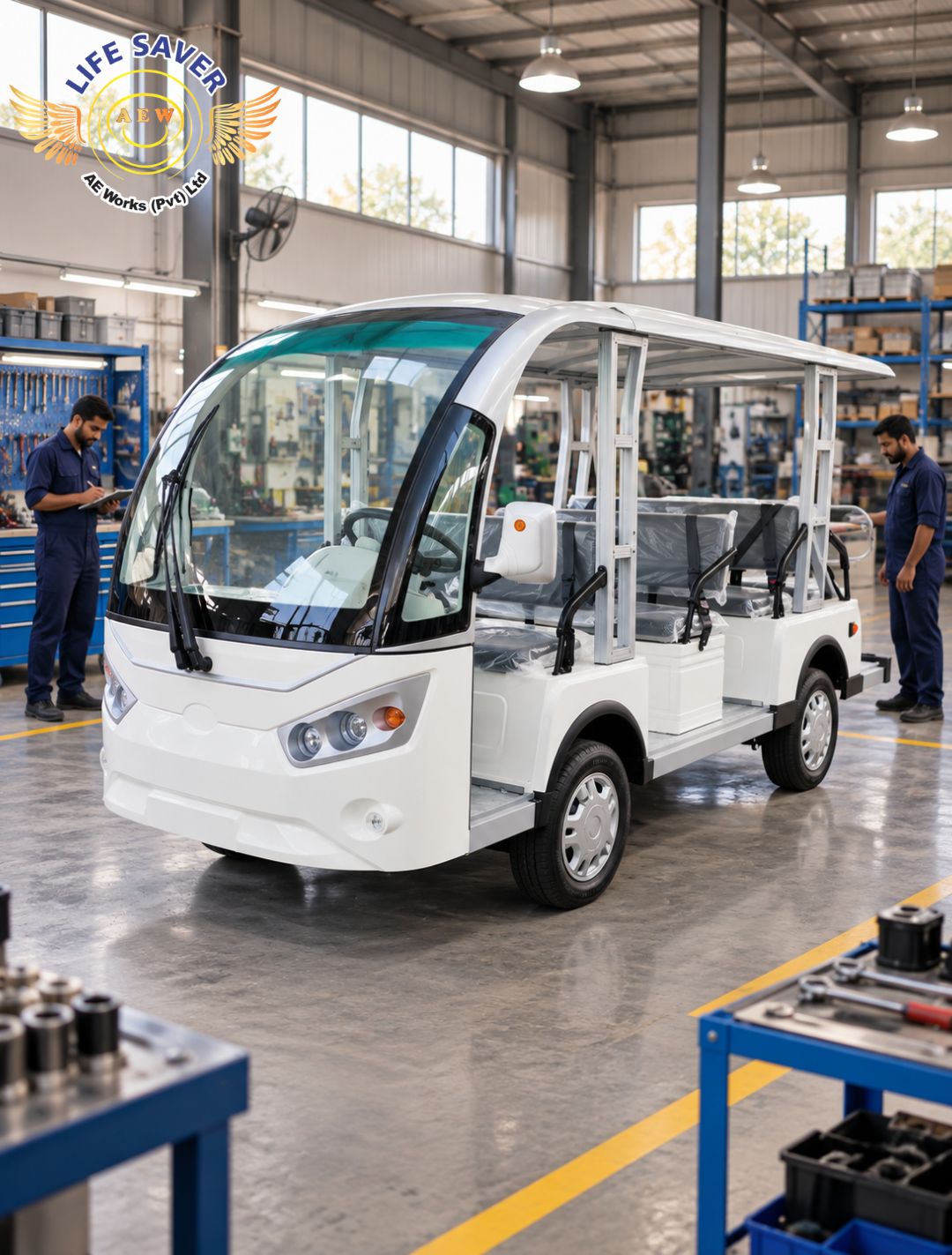
AE Works currently presents electric shuttle configurations covering 8, 11, 14, and 23 passengers. The individual model pages provide the clearest technical figures. Because some category-level summaries differ from those detailed pages, procurement decisions should use the individual specification page as a reference and confirm final details through the quotation or technical sheet.
Passenger capacity is only one part of selection. Vehicle dimensions, route width, motor specification, battery configuration, charging opportunities, passenger throughput, and braking arrangement also matter. The live model pages provide different specifications for each shuttle, supporting an application-first comparison rather than a simple “bigger is better” decision.
| AE Works model | Listed capacity | Motor information | Listed range | Overall dimensions |
|---|---|---|---|---|
| SD-8 | 8 passengers | AC 48–72V | 80–100 km loaded | 3900 × 1500 × 2050 mm |
| 11-Seater | 11 passengers | AC 48–72V, 7.5 kW | 80 km | 4650 × 1500 × 2050 mm |
| SD-14 | 14 passengers | 72V, 7.5 kW | 80 km | 5180 × 1510 × 2050 mm |
| SD-23A | 23 passengers | AC 72–96V | 100–200 km | 6180 × 1840 × 2150 mm |
The specifications above come from the current individual AE Works model pages.
Choosing Between 8, 11, 14 and 23 Seats
Smaller vehicles may suit tighter routes and frequent departures. Larger shuttles can reduce trip frequency when passenger demand peaks. Yet more seats also mean a larger physical footprint. The SD-23A, for example, is listed at 6180 mm long and 1840 mm wide. Fleet sizing should balance capacity with manoeuvrability.
For current model information, review the AE Works electric shuttle bus range before preparing a final procurement specification.
Charging, Maintenance and Fleet Uptime After Fabrication
Charging strategy can make or break an electric fleet. A vehicle needs enough usable energy for its duty cycle, but it also needs realistic time to recharge. Overnight charging may work for one fleet. Another may need charging between shifts. Pakistan’s current NEV framework also recognises charging infrastructure as part of wider electric-mobility development.
For commercial fleets, facility charging can offer useful control. The U.S. Department of Energy notes that EV fleets can charge at their own facilities during overnight or idle periods. Site electrical capacity, parking layout, charger location, future expansion, and vehicle schedules should therefore enter planning before deployment rather than after vehicles arrive.
Maintenance, Uptime and Real Operating Costs
All-electric vehicles generally require less routine powertrain maintenance than combustion vehicles because they have fewer moving parts and fewer fluids requiring regular service. However, tyres, brakes, steering, suspension, batteries, electronics, and charging equipment still need inspection. Lower maintenance doesn’t mean maintenance-free operation.
Real operating costs also depend on utilisation, electricity prices, battery life, maintenance, and downtime. Potential diesel fuel reduction only applies when electric vehicles actually replace diesel-powered journeys. Likewise, lower tailpipe carbon dioxide emissions should not be confused with zero lifecycle impact because electricity generation and vehicle production also create emissions.
How to Choose an Electric Utility Vehicle Fabrication Partner in Pakistan
A capable fabrication partner should ask detailed questions before suggesting a vehicle. Passenger volume, route length, gradients, working hours, charging access, turning space, and operating environment all deserve attention. This requirement-first approach matters because specialised electric vehicle manufacturing and customisation should solve repeatable operational needs instead of simply selling the largest available model.
AE Works describes its process in the same order. It first aims to understand the industry and operating requirement, then plans the engineering approach, carries out fabrication or customisation, and prepares the finished vehicle for its intended application. Its wider offering covers passenger mobility, healthcare, security, commercial, institutional, and industrial requirements.
Ask for a model-specific technical specification
Before ordering, confirm passenger capacity, battery type, motor, controller, charger, braking, dimensions, range basis, optional equipment, and selected configuration in writing. Website specifications are useful for research, but a signed quotation or technical sheet should define the actual vehicle being supplied. That reduces ambiguity and creates a clearer procurement record.
The AE Works project enquiry route remains the logical internal next step once the duty cycle is defined. Contact AE Works about a vehicle project
Understanding Broader EV Manufacturing Terms
Commercial EV research often introduces factory terminology that does not directly describe AE Works’ listed shuttle fabrication. A major OEM may use stator production, battery pack assembly, sub-assembly lines, motor and transmission assembly, and extensive powertrain assembly within one integrated factory. Those concepts belong to wider industrial EV production.
The same caution applies to manufacturing modernization, a pilot-scale assembly line, and a pilot production line. These phrases describe manufacturing-development methods used in larger production programmes. They should remain educational context unless AE Works publishes direct evidence that those specific processes form part of its own operation.
Electric Utility Vehicle Fabrication and Pakistan’s Changing Transport Landscape
Pakistan’s new-energy transition covers more than passenger cars. Government policy material addresses several classes of vehicles within the wider NEV ecosystem. That means medium-duty vehicles, medium-duty electric trucks, buses, two- and three-wheelers, and other commercial platforms can increasingly appear in Pakistan’s electric-mobility discussion.
AE Works’ current electric catalogue is narrower and clearer. The live Electric Vehicles section currently presents electric shuttle buses rather than electric medium-duty trucks. Keeping that distinction explicit strengthens trust. It gives readers useful market context without implying that AE Works sells a vehicle category that does not currently appear in its electric product range.
Electric Vehicles and Environmental Claims
Battery-electric vehicles produce no direct tailpipe emissions while operating. The U.S. Department of Energy also explains that electricity generation, material production, battery manufacturing, recycling, and vehicle production contribute to lifecycle emissions. For that reason, zero-emission vehicles is most accurate when referring to direct or tailpipe emissions, not every environmental impact.
Smarter Fleet Power Starts With the Right Requirement
Electric utility vehicle fabrication works best when every specification answers a practical question. How many people need transport? How far will they travel? Where will the vehicle charge? Which gradients must it handle? How much turning space exists? Those answers matter more than a long feature list because they determine whether the vehicle works every day.
For organisations in Pakistan, AE Works’ current 8-, 11-, 14-, and 23-passenger electric shuttle configurations provide several starting points for controlled-route mobility. The sensible approach is to match the shuttle to its duty cycle, verify model-specific technical details, and confirm the final configuration before procurement or fabrication begins.
The Wider Technology Picture
Across the wider industry, range-extended vehicles, advanced electric motors, evolving electric powertrain architectures, and other alternative energy vehicles continue to expand fleet choices. Yet the principle remains straightforward: the strongest fleet vehicle isn’t necessarily the one with the longest specification sheet. It is the one that reliably performs the required work.
Frequently Asked Questions
What is the process of manufacturing electric utility vehicles?
The process normally covers design, structural or body work, electrical integration, braking and suspension installation, controls, testing, and final inspection. Larger manufacturers may also perform battery pack assembly, component production, and powertrain integration. The exact process depends on vehicle class, production scale, localisation, and manufacturer capability.
How does electric utility vehicle fabrication differ from traditional diesel truck production?
A battery-electric drivetrain replaces the diesel engine, fuel tank, exhaust system, and many fuel-related components with a traction battery, electric motors, power electronics, controllers, and charging equipment. The assembly process therefore places greater emphasis on electrical architecture, battery integration, thermal management, high-voltage safety, and charging compatibility.
What materials and components are used in electric utility vehicle fabrication?
Common construction can involve steel, aluminium, fibreglass or other composites, glazing, wiring, interior materials, and vehicle-specific trim. Major electrical and mechanical systems may include battery packs, motors, controllers, chargers, brakes, steering, suspension, lighting, instrumentation, and safety equipment. Actual materials depend on the chosen vehicle design.
What are the key challenges in scaling electric utility vehicle manufacturing?
Scaling can require reliable battery and component supply, trained technical staff, repeatable processes, tooling investment, charging support, supplier consistency, traceability, and robust quality control. Larger factories must also manage production flow and specialised equipment. These challenges become more complex as output moves from custom builds toward high-volume electric vehicle manufacturing.
How much does it cost to set up an electric utility vehicle fabrication or assembly line?
There is no reliable universal figure. Capital requirements depend on output, automation, localisation, tooling, testing, building size, battery integration, body production, and whether major systems arrive as finished assemblies. A small custom fabrication operation and a highly automated automotive factory are fundamentally different investments, so credible budgeting requires a defined production scope first.