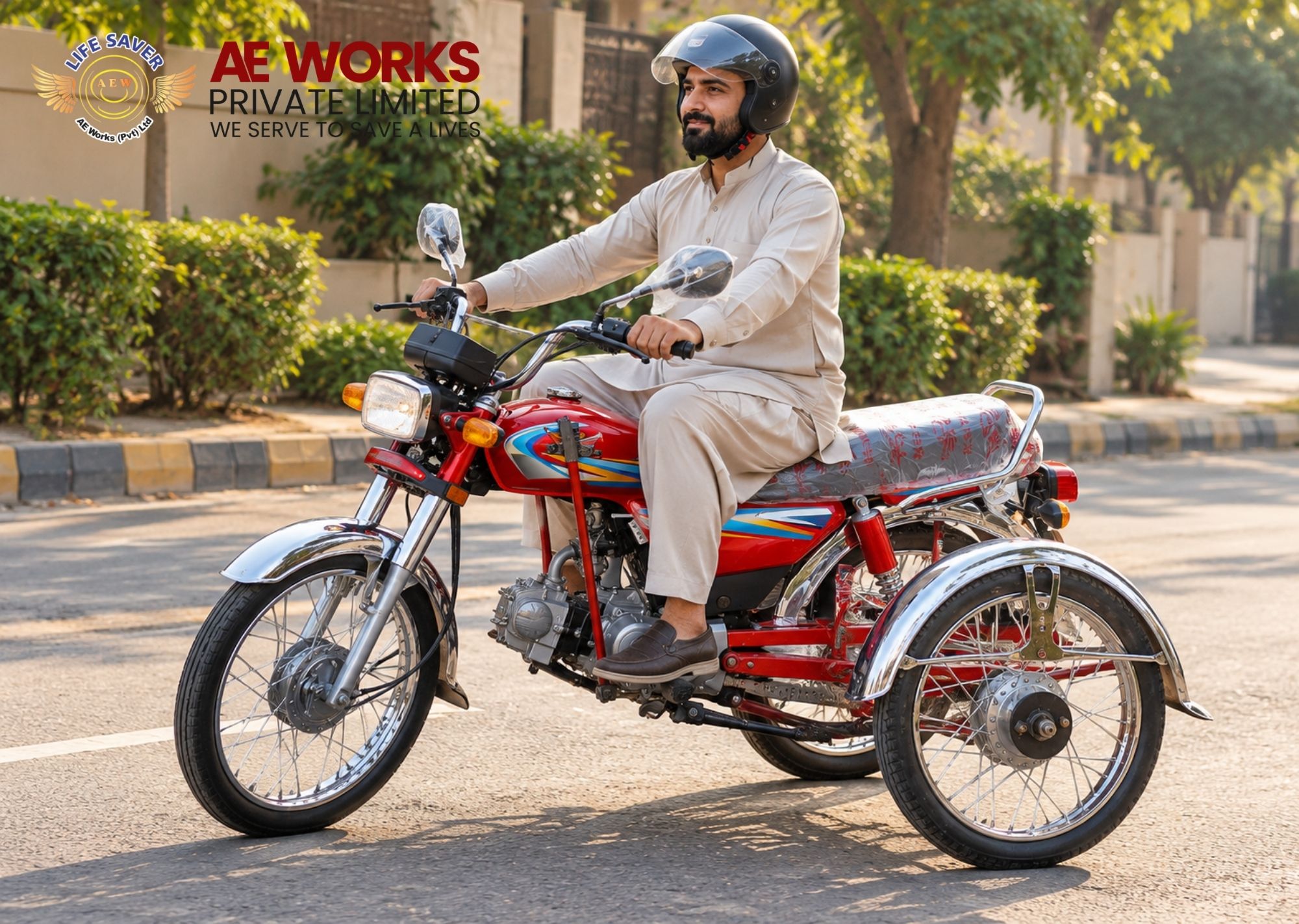
Industrial fires can turn a small ignition into an emergency within minutes, especially when access roads, storage zones, or parked vehicles slow larger appliances. An industrial fire response bike gives trained teams a compact way to reach developing incidents quickly with fire suppression gear, a high-pressure water/foam system, emergency communication radio, and equipment. For factories, warehouses, campuses, and industrial estates in Pakistan, the value lies in early access, not replacing a fire engine. A well-planned bike supports assessment, initial fire suppression, communication, and scene control while heavier resources approach. The right configuration must match site hazards, rider training, payload limits, maintenance routines, and the facility’s wider fire safety plan.
What Is an Industrial Fire Response Bike?
An industrial fire response bike is a specialised firefighting bike configured to carry selected firefighting equipment through areas where larger vehicles may move slowly. Think of it as a mobile first responder platform. Its purpose is rapid access, early assessment and controlled intervention during the developing stage of an incident.
Unlike an ordinary motorcycle carrying an extinguisher, a properly engineered fire fighter bike integrates its equipment around balance, access and operational needs. AE Works describes options involving suppression equipment, mounted storage, warning systems and communications. Its existing Fire Fighting Bike can be explored through the official product page. AE Works Fire Fighting Bike
Why Pakistani Industrial Sites Need Faster First Response
Industrial facilities can contain long internal roads, production buildings, loading areas, workshops and distant warehouses. A conventional emergency vehicle remains essential. However, its size may restrict movement through congested internal routes. A motorcycle can give an industrial safety unit another mobility option when the incident lies beyond immediate walking distance.
Pakistan already has practical evidence that motorcycles can reduce access delays in emergencies. Punjab Rescue 1122 reports that its Motorbike Rescue Service has handled millions of emergencies with an average response time below four minutes. That programme provides medical response rather than firefighting, yet it demonstrates the mobility advantage motorcycles can offer in congestion.
How an Industrial Fire Response Bike Works
A response begins with mobility rather than brute capacity. The rider travels with selected fire suppression gear, reaches the incident, evaluates conditions and communicates what heavier crews need. Depending on the approved configuration and fire type, a fire suppression system may then support controlled early action while the site's main emergency arrangements continue.
AE Works describes a pump and delivery mechanism capable of moving water or foam through a hose system. Its product information also refers to an adjustable nozzle for controlling discharge patterns. These components must work as an integrated system because unstable mounting or unsuitable equipment can compromise both handling and safe operation.
Fire Suppression Equipment and Payload Integration
Equipment choice should begin with the hazards on site, not with a desire to carry everything. AE Works describes ABC dry chemical fire extinguishers, a hose reel, first-aid equipment and communications among potential bike equipment. A configured high-pressure water/foam system may also support early intervention where the selected extinguishing medium suits the hazard.
Mounting deserves equal attention. Equipment that shifts under braking can disturb motorcycle handling at precisely the wrong moment. AE Works therefore describes custom vibration-resistant brackets and dedicated storage. The total arrangement should leave essential equipment accessible while maintaining sensible weight distribution, rider movement and clear access to emergency controls.
Where Fire Response Bikes Fit Inside Industrial Facilities
Large factories and industrial and warehouse complexes are particularly relevant because an incident may occur far from the main gate or fire-appliance parking area. AE Works itself identifies industrial and warehouse environments as a Fire Fighting Bike application, making industrial response a genuine use case rather than an invented marketing angle.
Useful deployment points may include production zones, warehouse corridors, utility areas and widely separated buildings where vehicle access remains suitable. However, an industrial fire response bike shouldn't become the entire safety strategy. Punjab Civil Defence identifies alarms, extinguishers, hydrants, sprinklers, evacuation planning and fire-control arrangements among industrial fire-safety measures.
Industrial Fire Response Bike vs Fire Engine
A motorcycle and a fire engine solve different problems. The bike prioritises access, speed and early intervention. The larger appliance provides significantly greater crew, extinguishing-agent capacity and specialised equipment. Treating them as competitors misses the point. Effective emergency planning places each asset where its capabilities add the most value.
| Response factor | Industrial fire response bike | Full fire appliance |
|---|---|---|
| Primary strength | Fast, compact access | Major firefighting capacity |
| Typical role | Initial assessment and early action | Sustained incident control |
| Access | Useful on suitable narrow internal routes | Requires greater road clearance |
| Personnel capacity | Very limited | Multiple responders |
| Suppression capacity | Compact and configuration-dependent | Considerably greater |
| Best relationship | Supports the response system | Main heavy-response resource |
That distinction also improves emergency response requirements planning. A bike can potentially reach a developing event first and relay information through an emergency communication radio. Meanwhile, the larger response continues towards the scene with additional personnel and resources. HNE similarly positions firefighting motorcycles around rapid intervention rather than replacement of larger apparatus.
Designing the Bike Around Industrial Fire Risks
Every facility presents a different hazard profile. A textile warehouse, engineering workshop and logistics yard should not automatically receive identical equipment. Before fabrication, buyers should identify likely fuel sources, electrical hazards, flammable liquids, route widths, surface conditions, operating distances and the intended role of the rapid-response team.
Only then should storage, suppression and visibility requirements be specified. Possible AE Works features include LED emergency lighting, a siren and public address system, reflective livery and communications. The configuration should also respect the base motorcycle's load, handling and braking characteristics rather than turning a nimble response machine into an overloaded equipment rack.
Rider Safety, Training and Emergency Coordination
Speed has little value without disciplined operation. Riders need appropriate motorcycle competence plus training for the specific suppression equipment they carry. Rider safety gear, site communication procedures, safe approach distances and escalation rules should form part of routine preparation. The rider must know when early action is reasonable and when withdrawal is the safer decision.
Coordination matters just as much. A responder may arrive before heavier resources, but that doesn't mean acting alone. The rider can report fire location, visible hazards, access restrictions and required support. AE Works also describes an emergency communication radio, first-aid kit and forcible entry tools among potential equipment provisions.
Inspection, Maintenance and Operational Readiness
A response motorcycle that fails to start during an alarm becomes expensive decoration. Daily readiness should therefore consider tyres, brakes, fuel or energy status, mounting security, warning systems and visible damage. Suppression equipment also needs scheduled inspection so the hose reel, connections, nozzle and stored extinguishing media remain serviceable.
Readiness should extend beyond the motorcycle itself. Teams need clear reporting for defects, maintenance history and post-use replenishment. The site's wider emergency response requirements should define who inspects the vehicle, who authorises its return to service and how operators communicate faults before the next emergency occurs.
Choosing an Industrial Fire Response Bike in Pakistan
Procurement should start with the job the motorcycle must perform. Define the facility layout, operating routes, expected hazards, rider numbers, required response radius and desired fire suppression gear before choosing equipment. Buyers should also ask how added weight affects handling and how maintenance access has been preserved after fabrication.
AE Works currently offers specialised bike fabrication for firefighting, rescue, healthcare and other applications. Its Fire Fighting Bike page describes customisation around client requirements rather than presenting every unit as identical. Buyers can therefore begin with the existing product and discuss an industrially appropriate configuration instead of assuming a universal specification. AE Works Customised Bikes
Frequently Asked Questions
What is a fire bike?
A fire bike is a specially configured motorcycle that carries selected firefighting or emergency equipment for rapid access and early response.
How does a fire motorcycle help in emergencies?
A firefighting bike can move through suitable restricted routes quickly, allowing trained responders to assess the incident and begin appropriate early action.
Can a fire bike replace a fire engine?
No. A bike has limited personnel and suppression capacity. It should complement fire engines, fixed systems and the site's wider emergency response plan.
What kind of maintenance do fire motorcycles require?
They require normal motorcycle maintenance plus inspections of mounted suppression equipment, hoses, storage systems, warning lights, communications and equipment restraints.
Are fire bikes used outside cities?
Yes. Appropriate units can support factories, warehouses, campuses, industrial estates and other sites where compact mobility offers a practical access advantage.